You have the right to the road. New Hampshire recognizes that. You can ride without a helmet if you are 18 or older. You can take I-93 on a Friday afternoon in July with your face in the wind and the law behind you. That freedom is real.
What many riders do not know is what happens next. What happens the moment another driver cuts across your lane, or runs a stop sign at a rural Nashua intersection, or opens a car door directly into your path.
Because in that moment, the insurance company on the other side is not thinking about your rights. They are thinking about one thing: how do they minimize what they pay you? And the first tool they reach for is the helmet you were not wearing.
This is the hidden problem in NH motorcycle accident claims. The law protects your right to ride without a helmet. The insurance industry uses that same choice against you when you file a claim.
Here is what riders and their families need to understand.
New Hampshire's No-Helmet Law and What It Actually Means
Under New Hampshire RSA 265-A:17, adults 18 and older are not required to wear a helmet while riding a motorcycle. This is one of the most permissive motorcycle laws in the country. New Hampshire is one of only three states with no universal helmet requirement.
What it means legally: riding without a helmet is not negligence in New Hampshire. It is a legal choice. A jury in New Hampshire cannot find you comparatively at fault simply because you were riding without a helmet.
What it means practically: insurance adjusters do not follow legal rules in the same way courts do. The adjuster evaluating your claim may argue that your head injuries were more severe because you were not wearing a helmet, and that you should bear some portion of the financial consequences. They may use language like "assumption of risk" or "failure to mitigate damages." These arguments are legally weak in New Hampshire courts, but they are used aggressively in settlement negotiations where most cases resolve.
Having an attorney who understands New Hampshire's helmet law and can push back against these tactics in real time changes the outcome.
How Comparative Fault Works for Riders
New Hampshire follows a modified comparative fault standard. If you are more than 50 percent at fault for the accident, you recover nothing. If you are less than 50 percent at fault, your recovery is reduced by your percentage of fault.
In motorcycle accident cases, insurance adjusters work hard to assign riders a share of fault. Common arguments they use:
You were speeding. Even if the other driver caused the crash, any evidence that you were exceeding the speed limit will be used to assign you partial fault. Dashcam footage, traffic camera data, and witness accounts will be reviewed for this.
You were lane splitting. Lane splitting is illegal in New Hampshire. If you were riding between lanes of stopped or slowed traffic, the carrier will argue this contributed to the accident even if the other driver's conduct was the primary cause.
You were riding with reduced visibility. If the accident happened at night or in rain, adjusters will look for any argument that your visibility or reaction time contributed to the crash.
You were following too closely. Rear-end crashes where a car stops suddenly and a motorcycle cannot stop in time are often assigned partial fault to the rider even when the car driver's sudden stop was itself negligent.
The key to fighting these arguments is evidence gathered immediately after the accident: police report, witness statements, photographs of the scene, road conditions, the other driver's vehicle position, and any available traffic or security camera footage.

Motorcycle Injuries Are Catastrophic. Your Compensation Should Reflect That.
Riders do not have crumple zones, airbags, or seat belts. When a motorcycle crash happens at highway speed, the rider's body absorbs the full impact. The injuries that result are fundamentally different from typical car accident injuries in their severity and long-term consequences.
Common serious injuries in New Hampshire motorcycle accidents include:
- Road rash ranging from surface abrasions to deep tissue damage requiring skin grafting
- Traumatic brain injury (TBI), including concussion, intracranial bleeding, and long-term cognitive effects, which can occur even with a helmet at high speeds
- Spinal cord injuries causing partial or complete paralysis
- Broken bones, particularly to the arms, legs, collarbone, and pelvis from impact and fall
- Internal organ damage from blunt force trauma
- Degloving injuries, which involve the separation of skin and tissue from underlying structures, particularly on the legs and arms
These injuries have long recovery timelines, often require multiple surgeries, and frequently result in permanent disability. Calculating the full value of a serious motorcycle accident claim requires accounting not just for current medical bills but for future medical care, long-term lost earning capacity, and the profound impact on quality of life.
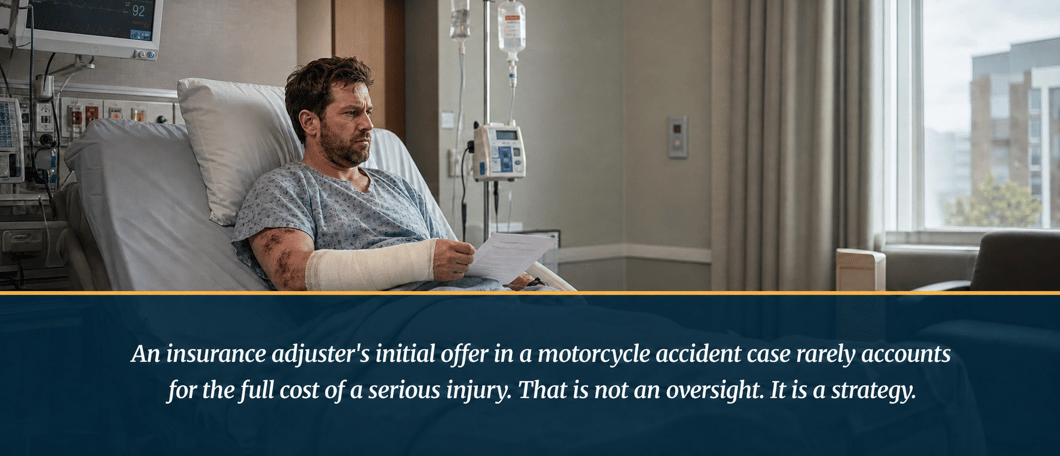
An insurance adjuster's initial offer in a motorcycle accident case rarely accounts for the full cost of a serious injury. That is not an oversight. It is a strategy.
The Summer Pattern in New Hampshire
New Hampshire's motorcycle accident rate follows a predictable seasonal curve. Ridership increases sharply from May through September, peaks in July and August, and falls off in October. The same roads that carry summer tourist traffic carry significantly more motorcycle traffic during these months.
Several conditions specific to New Hampshire summers create elevated risk for riders:
Inexperienced seasonal riders. People who have not ridden since the previous fall are back on motorcycles before their reflexes and habits are fully recalibrated. This is true for NH residents and out-of-state riders visiting on summer trips.
Tourist and vacation traffic. Drivers unfamiliar with New Hampshire roads are more likely to make unexpected maneuvers. The Weirs Beach corridor, Route 16 through the Ossipee area, and Franconia Notch are summer rider destinations that also see high tourist car traffic.
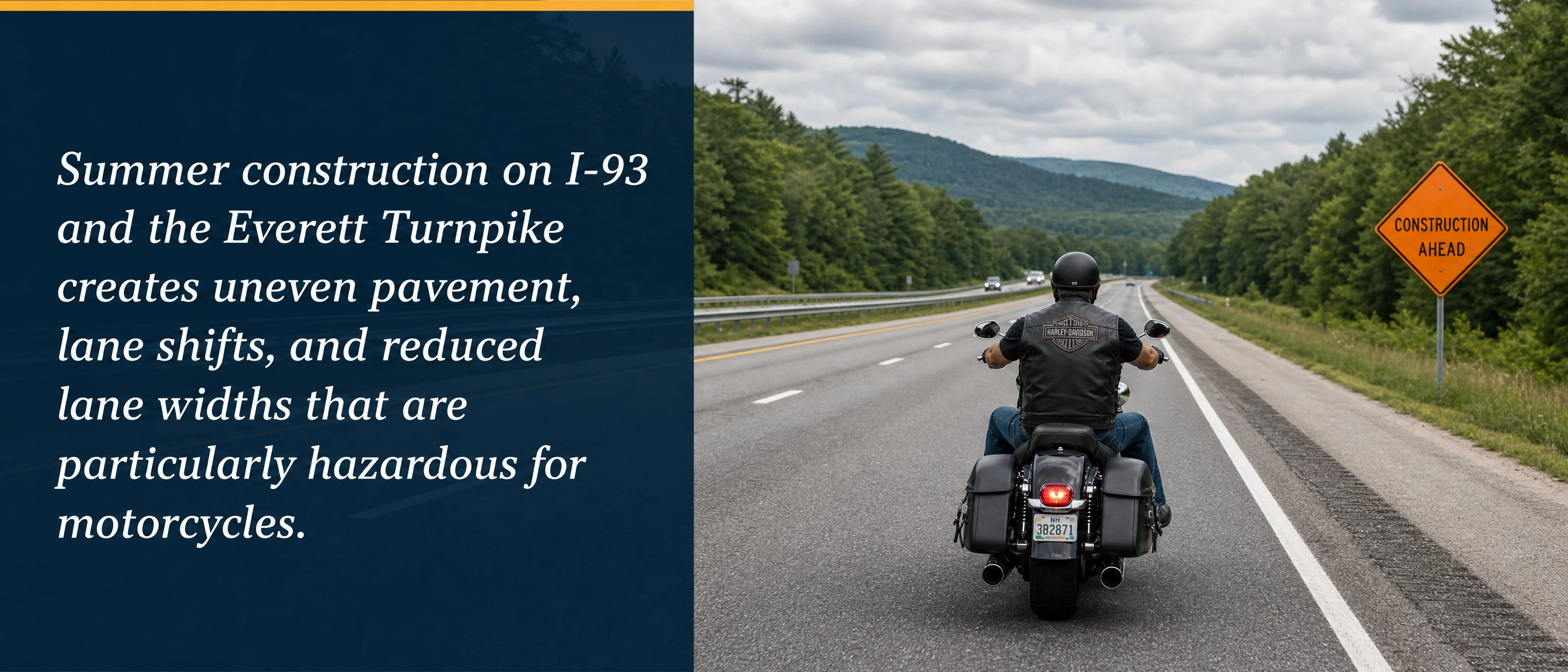
Road construction zones. Summer construction on I-93 and the Everett Turnpike creates uneven pavement, lane shifts, and reduced lane widths that are particularly hazardous for motorcycles.
Intersection accidents in Nashua and Manchester. Urban intersections, particularly at busy commercial corridors like Daniel Webster Highway, South Willow Street, and Amherst Street in Nashua, are high-frequency locations for left-turn accidents where a driver fails to see an oncoming motorcycle.
The left-turn accident deserves specific mention. When a car driver makes a left turn through an intersection and misjudges the speed of an oncoming motorcycle, the motorcycle typically impacts the turning vehicle broadside. This is the most common type of fatal motorcycle accident in the United States and in New Hampshire. The claim in these cases often looks clear, but the carrier for the left-turning driver will still attempt to assign fault to the rider for excessive speed or failure to observe.
What Families Need to Know
When a motorcycle accident results in death, the surviving family members have rights under New Hampshire's wrongful death statutes. The estate of the deceased rider can pursue a claim for the rider's medical expenses, pain and suffering in the period between the accident and death, and funeral expenses. The spouse and children of the deceased rider can pursue damages for loss of support, loss of companionship, and loss of services.
Wrongful death claims in motorcycle accidents are complicated by the same insurance and fault issues that affect injury claims, amplified by the stakes involved. If your family member was killed in a motorcycle accident in New Hampshire, the attorneys at Buckley Law Offices can evaluate your wrongful death claim at no cost and no obligation.
Frequently Asked Questions About NH Motorcycle Accident Claims
Does not wearing a helmet mean I cannot recover? No. Under New Hampshire law, helmet choice is not a basis for finding comparative fault. An attorney can fight any attempt by the insurance company to use your helmet choice against you.
What if the driver says they did not see me? "I didn't see you" is not a legal defense. Drivers have an obligation to look for motorcycles, especially at intersections. The driver's failure to observe you is negligence.
What if I was partially at fault? New Hampshire's modified comparative fault rule allows you to recover as long as you are not more than 50 percent at fault. Your recovery is reduced by your percentage of fault, but you are not barred from it unless you cross the 50 percent threshold.
Can I recover for damage to my motorcycle? Yes. Property damage claims for the motorcycle, gear, and other personal property are separate from your personal injury claim but are part of the overall recovery.
How much is my motorcycle accident case worth? This depends on the severity of your injuries, your lost income, your future medical needs, and the specific facts of the accident. The consultation with Buckley Law Offices is free and will give you a realistic assessment of your claim's value.
You have the right to the road. When someone takes that right away, the consequences can change your life. The attorneys at Buckley Law Offices will fight for everything you are owed.
Injured in a motorcycle accident.
Been injured? Call Buckley! (603) 595-8801 for a free consultation.