Most New Hampshire residents involved in a car accident believe the case is straightforward: someone caused the crash, someone else got hurt, and the at-fault driver pays.
The legal reality is more complicated. In New Hampshire, both sides of a collision can share responsibility, and the percentage of fault assigned to each party directly determines how much compensation the injured person receives.
This system is called modified comparative fault, and it is one of the most important legal concepts in New Hampshire personal injury law. It is also one of the most misused tools in the insurance industry's playbook.
The Basic Rule in Plain Language
Under New Hampshire RSA 507:7-d, a plaintiff can only recover damages if their own fault is not greater than the combined fault of all other defendants.
In practice, this means:
- If you are 50 percent or less at fault, you can recover. Your recovery is reduced by your percentage of fault.
- If you are 51 percent or more at fault, you recover nothing.
This is often called the "51 percent rule" or the "50/50 threshold." New Hampshire's version is considered "plaintiff-friendly" compared to stricter states that bar recovery at any percentage of fault, but it still creates significant financial consequences for claimants who are assigned even modest shares of fault.
A concrete example: You are injured in a car accident. A jury determines your total damages are $100,000. The jury also finds that the other driver was 70 percent at fault and you were 30 percent at fault. Under the comparative fault rule, your recovery is reduced by 30 percent. You receive $70,000, not $100,000.
The threshold in action: Same facts, but the jury finds you were 55 percent at fault. You recover nothing, regardless of how serious your injuries are.
Why Insurance Companies Focus Heavily on Your Share of Fault
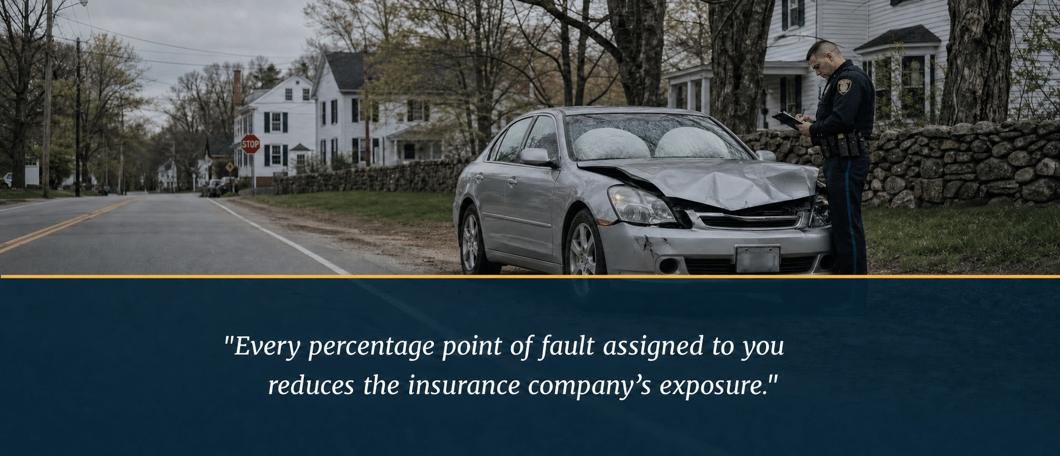
Every percentage point of fault assigned to you reduces the insurance company's exposure. This is why adjusters spend so much time in their initial investigation looking for evidence that you contributed to the accident.
After a car accident, an insurance adjuster is not simply trying to understand what happened. They are specifically looking for:
- Your speed at the time of impact (above the limit, or too fast for conditions)
- Your phone use in the moments before the crash (cell records, in-car data)
- Your following distance if the crash involved a rear-end collision
- Your lane position and whether you drifted or made an unexpected maneuver
- Your reaction time, which they may try to connect to distractions or impairment
- Road conditions you could have anticipated, such as a wet surface you had been traveling on for miles
They are building a case that you share fault. They will use this both to reduce any settlement offer they make and, if the case goes to litigation, to present to a jury.
The difference between being found 20 percent at fault and 40 percent at fault in a $100,000 case is $20,000. In a $500,000 case, it is $100,000. The insurance company employs people whose only job is to manage this number.
How Fault Is Determined
Fault in a New Hampshire car accident case is determined by the totality of available evidence. No single piece of evidence is automatically dispositive, but some categories carry significant weight.
The police report. New Hampshire State Police and local department reports often contain an officer's preliminary assessment of fault. This is not binding in a civil lawsuit, but insurance adjusters and juries pay attention to it. If an officer issued a citation to the other driver, that citation is strong evidence of fault.
Physical evidence from the scene. The final positions of the vehicles, the location of impact damage, skid marks, debris patterns, and traffic control devices visible in photographs all help reconstruct what happened. An accident reconstruction expert can translate this physical evidence into a professional opinion on fault percentages.
Electronic data. Modern vehicles have event data recorders (EDRs) that capture speed, braking, steering, and throttle position in the seconds before a collision. Both your vehicle and the other driver's vehicle may contain this data. This is valuable evidence that must be preserved quickly, before a vehicle is repaired or scrapped.
Witness statements. Independent witnesses who saw the accident and have no relationship to either party carry substantial credibility. Their accounts of what happened, including factors like the other driver's speed or distraction, can directly affect fault apportionment.
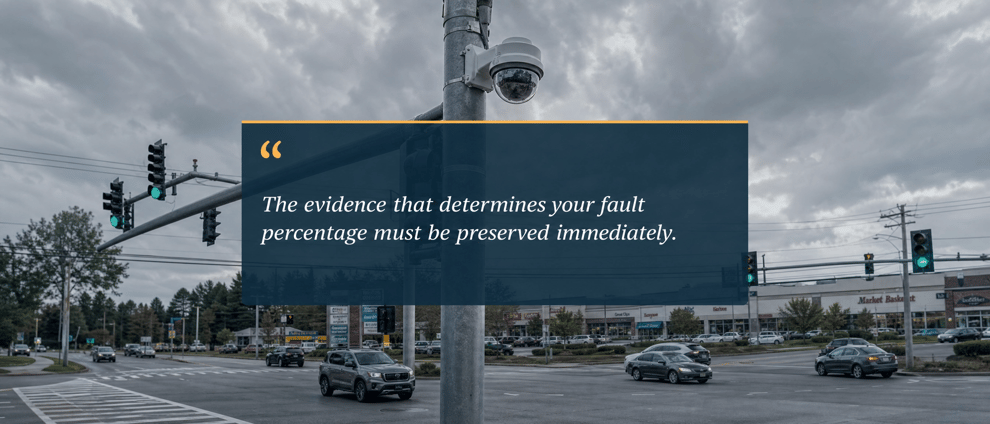
Traffic and security camera footage. In urban and suburban areas like Nashua, Manchester, and Salem, cameras at intersections and commercial properties often capture accidents. This footage is among the most objective evidence available, and it disappears fast if not preserved.
The "Shared Fault" Conversation You Will Have With the Adjuster
At some point in your claim, the insurance adjuster will raise the issue of your shared fault. This conversation is not neutral. They are negotiating. Everything they say about your fault percentage is an argument designed to reduce their offer.
You do not have to accept their characterization. You do not have to agree with their fault assessment. And you should never agree to a fault percentage in a recorded statement without legal counsel, because that statement can be used against you in subsequent negotiations or litigation.
Common scenarios where comparative fault arguments arise in New Hampshire:
Rear-end collisions: New Hampshire does not have an absolute "presumption" that the rear driver is always at fault. If the lead driver stopped suddenly, cut off the other driver, or had non-functioning brake lights, comparative fault arguments can arise even when the trailing driver appears to be at fault.
Intersection accidents: When two vehicles approach an intersection and one runs a stop sign or red light, the analysis seems obvious. But if the other driver was speeding through the intersection, they may be assigned a portion of fault even though the first driver had the red light.
Left-turn accidents: When a driver making a left turn collides with an oncoming vehicle, the turning driver is usually primarily at fault. Insurance companies often argue that the oncoming driver was speeding, reducing their settlement obligation.
Parking lot accidents: Fault in parking lot collisions is often genuinely disputed. The rules of right-of-way in private lots are different from public roads, and fault assignments in these cases can be highly variable.
Multiple Defendants and How Fault Is Split
New Hampshire's comparative fault law does not just apply between the plaintiff and one defendant. When multiple defendants share fault, their individual percentages are compared against the plaintiff's percentage.
For example, if a construction contractor created a road hazard that contributed to an accident, the fault might be split three ways: the other driver, the contractor, and potentially you. Each defendant's liability to you is proportional to their share of total fault, unless the court applies joint and several liability principles.
This multi-party analysis is one reason truck accident cases and government road construction cases are particularly complex. The attorneys at Buckley Law Offices analyze every potential defendant in a case to ensure the full scope of liability is pursued.
Protecting Yourself Against Unfair Fault Attribution
The most effective protection against having your fault percentage inflated is having an attorney working on your case from the beginning. Here is why:
An attorney can issue immediate evidence preservation demands, preventing the other side from selectively destroying or withholding evidence that would reduce your assigned fault. An attorney can retain an accident reconstruction expert whose professional opinion competes with the insurance company's own analysis. An attorney can conduct independent witness interviews before memory fades.
And an attorney who knows New Hampshire comparative fault law can identify every argument the insurance company is likely to use and prepare a counter-analysis before negotiations begin.
David Buckley has been doing exactly this work in New Hampshire for more than 30 years. He understands how insurance companies build comparative fault arguments, and he knows how to dismantle them with evidence and legal analysis.
The three-year statute of limitations gives you time to file suit, but the evidence that determines your fault percentage must be preserved immediately. Acting early is the single most important thing you can do to protect your comparative fault position.
Frequently Asked Questions About NH Comparative Fault
What if I was clearly not at fault? Can the insurance company still raise comparative fault? Yes. The insurance company can raise any argument it believes has factual support. Your job, or your attorney's job, is to refute it with evidence. An unfounded comparative fault argument does not disappear on its own.
Does the police report determine my fault percentage? No. The police report is evidence, but it is not binding in a civil case. A jury or arbitrator makes the final fault determination based on all available evidence.
Can I still recover if I was texting at the time of the accident? Potentially, depending on the full facts. Cell phone distraction is a form of negligence that can contribute to your fault percentage, but it does not automatically bar recovery unless your resulting fault exceeds 50 percent.
What if the other driver also does not have insurance? If the other driver is uninsured, you pursue your own UM coverage. Your UM insurer may still raise comparative fault arguments to reduce what they owe you, even though they are your own carrier.
Does it matter which insurance company makes the fault determination? No. The at-fault driver's insurance company does not make the final legal determination of fault. They make an offer based on their assessment. You can dispute that assessment through negotiation or, if necessary, through litigation.
Understanding New Hampshire's comparative fault rules is the first step to protecting your recovery.
Been injured? Call Buckley! (603) 595-8801 for a free consultation.
David Buckley will analyze the facts of your case and give you an honest assessment of your fault exposure and your recovery potential.