On Behalf of Buckley Law Offices
Quick Summary
A New Hampshire slip and fall claim depends on more than the fact that someone fell. The key questions are what caused the fall, whether the property owner knew or should have known about the hazard, what evidence still exists, and how the injury was documented. Buckley Law Offices reviews slip and fall cases by looking at the hazard, the timing, the records, and the practical proof.
A fall can feel embarrassing before it feels legal.
People get up fast. They say they are okay. They leave the store, parking lot, sidewalk, restaurant, or apartment building because they do not want attention.
Then the pain settles in.
The problem is that slip and fall evidence can disappear almost as quickly as crash evidence. A spill gets cleaned. Ice melts. A mat gets moved. A camera records over the footage. The person who saw it goes home.
By the time the injury is clearly serious, the property may no longer show what caused the fall.
That is why early evidence matters in New Hampshire slip and fall accident cases.
The Hazard Matters
The first issue is not simply that someone fell.
The first issue is what caused the fall.
Useful details may include:
- water, ice, snow, grease, or another slippery substance
- broken stairs or railings
- uneven pavement
- poor lighting
- loose mats
- debris in a walkway
- unsafe parking-lot conditions
- a recurring maintenance problem
The more specific the hazard, the clearer the case review can be.
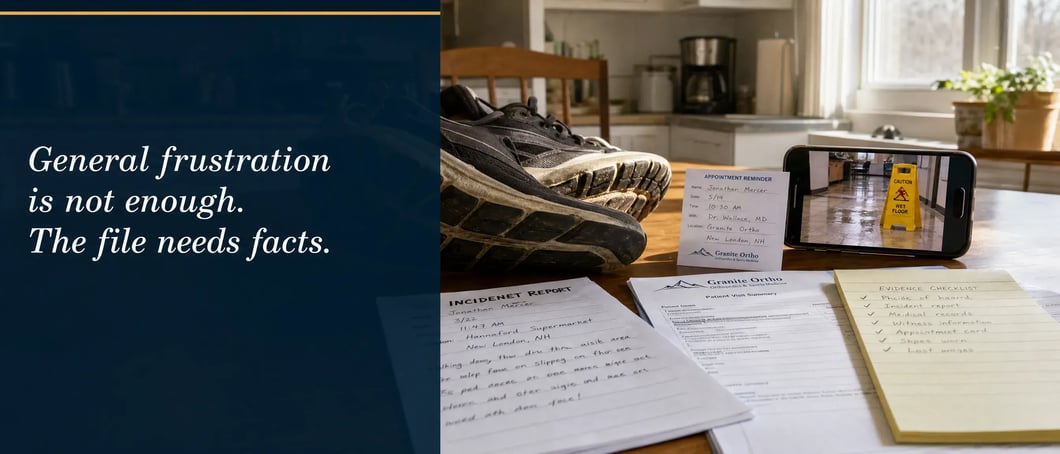
General frustration is not enough. The file needs facts.
The Property Ownser's Knowledge Matters
Slip and fall claims often turn on what the property owner knew or should have known.
That may involve how long the hazard existed, whether employees saw it, whether similar problems happened before, whether the area was inspected, or whether maintenance was reasonable under the circumstances.
An injured person may not know those answers right away.
That is why photographs, incident reports, witness information, and video preservation can be important.
A Common Evidence Problem After a Fall
A customer slips near the entrance of a Nashua business on a wet afternoon. She gets up quickly, tells the manager she thinks she is okay, and leaves without taking pictures because she is embarrassed. Two days later, the knee and back pain are worse, but the floor has been cleaned, the entrance mat has been moved, and the store's video may already be at risk of being recorded over. The fall may have been caused by a real hazard, but the proof is already thinner.
That is the practical problem.
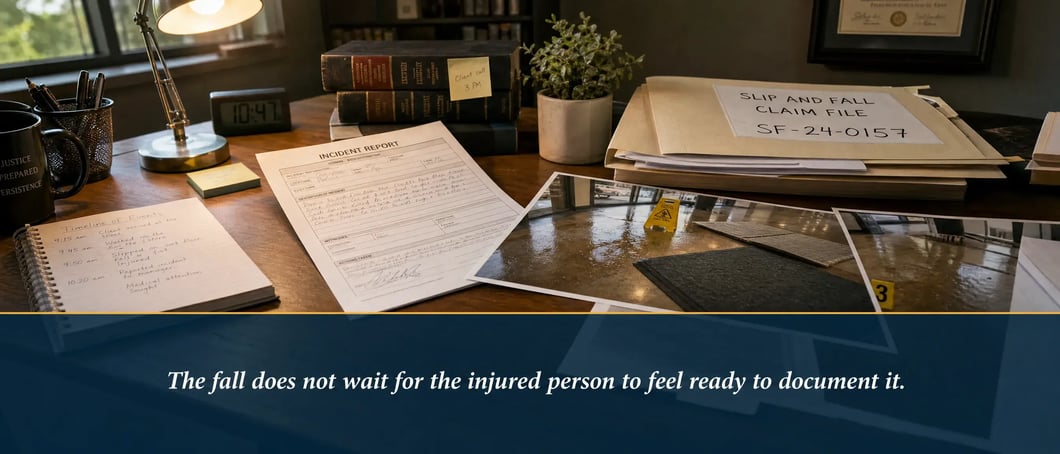
The fall does not wait for the injured person to feel ready to document it.
Early Evidence Can Protect the Claim
After a fall, useful evidence may include:
- photographs of the hazard
- photographs of the surrounding area
- names and contact information for witnesses
- an incident report
- the exact location of the fall
- shoes and clothing worn at the time
- weather conditions when relevant
- medical records
- follow-up treatment notes
If a business or property owner may have video, it should be identified quickly.
Medical Timing Still Matters
Slip and fall injuries can involve wrists, shoulders, knees, hips, backs, heads, and necks.
Some symptoms are obvious immediately. Others worsen after the person gets home.
As with auto accident cases, medical timing matters because it creates a record. If symptoms are present, getting checked and identifying every pain point helps connect the injury to the incident.
Waiting and hoping the pain fades may feel reasonable.
It can also create an avoidable gap.
Property Owners and Insurers May Push Back
Slip and fall cases are often contested.
The insurer may argue:
- the hazard was open and obvious
- the property owner did not know about it
- the injured person should have seen it
- the fall was caused by the injured person's own carelessness
- the injury was not as serious as claimed
- the medical record does not connect clearly
Buckley Law Offices reviews those arguments against the actual record, not just the property owner's version. In a disputed premises liability claim, the details around timing, maintenance, notice, and documentation can matter as much as the injury itself.
The Case Needs More Than a Quick Answer
People often want to know whether a property owner is responsible.
Sometimes the answer is clear. Often it depends on details that need to be gathered before they are gone.
The practical questions are:
- what caused the fall?
- how long was the hazard there?
- who knew or should have known?
- what proof still exists?
- when did treatment begin?
- does the medical record match the injury?
Those questions are what turn a fall from a general complaint into a case that can be evaluated.
The Goal Is a File That Can Be Explained
Buckley Law Offices does not treat every fall as a strong claim.
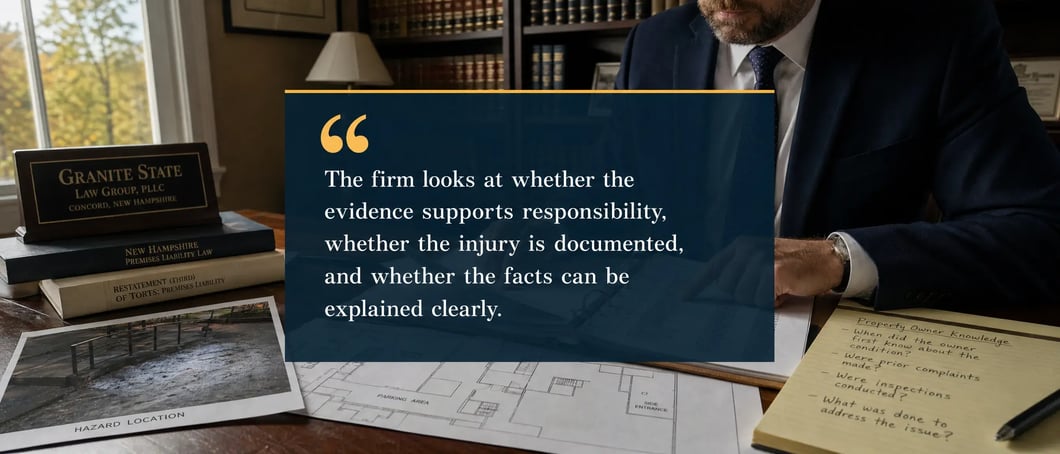
The firm looks at whether the evidence supports responsibility, whether the injury is documented, and whether the facts can be explained clearly to an insurance company or, if needed, in litigation.
That is a practical review, not a slogan.
If you were hurt in a New Hampshire fall and need help understanding what evidence may matter, Call Buckley at (603) 595-8801.