July and August bring hundreds of thousands of visitors to New Hampshire. They are heading to the Lakes Region, the White Mountains, Hampton Beach, and the outlet stores in North Conway. They are driving rental cars with unfamiliar GPS systems.
They are merging onto the Everett Turnpike at 45 miles per hour because they misjudged the ramp. They are making U-turns on Daniel Webster Highway because they missed an exit.
Most of them drive safely. But some of them cause serious accidents, and when they do, the people they hurt face a layer of complexity that does not exist in a typical New Hampshire accident.
This article is for anyone who has been hit by an out-of-state driver in New Hampshire, or who wants to understand their rights before that happens.
New Hampshire Law Still Applies
The most important thing to understand: the law of the state where the accident happened controls the case. If a Massachusetts driver rear-ends you on I-93 in Nashua, New Hampshire law applies. Not Massachusetts law. Not the law of whatever state the driver is from.
This means:
- New Hampshire's fault rules apply to your claim
- The statute of limitations is New Hampshire's three-year window, not the driver's home state window
- New Hampshire courts have jurisdiction over the case if it goes to litigation
- The at-fault driver's insurance company must follow New Hampshire claims handling rules
This is actually an important protection. Some states have shorter statutes of limitations and more restrictive comparative fault rules than New Hampshire. Because the accident happened here, you get the benefit of New Hampshire law.
The Insurance Complication
Here is where things get practically difficult. The at-fault driver's insurance policy was issued in their home state. That insurance company is staffed with adjusters trained in that state's law and procedures. They may not be familiar with New Hampshire-specific requirements, and in some cases, they will deliberately use that unfamiliarity to delay or minimize your claim.
Common tactics used by out-of-state insurance companies in NH accident claims:
Slow-walking the investigation. An out-of-state carrier may claim they need more time to "investigate the New Hampshire aspects of the claim." This is often a delay tactic. New Hampshire has specific claims handling regulations that require timely responses, but a carrier that does not operate here regularly may not follow them unless pushed.
Applying the wrong legal standard. Some adjusters will attempt to evaluate your claim under their home state's law rather than New Hampshire's. For example, some states have stricter no-fault frameworks that would reduce your recovery. New Hampshire is not a no-fault state. If an adjuster is treating your claim as though it is, that is wrong.
Offering a fast, low settlement before you know your full damages. This is common in any accident case, but particularly so when the at-fault driver is from out of state and the carrier wants to close the file before a New Hampshire attorney gets involved. A check for $2,500 mailed to your home three weeks after the accident is almost always far less than your case is worth.
Using your unfamiliarity with the process. Out-of-state carriers know that people who have never dealt with a personal injury claim before do not know what questions to ask, what information to gather, or what their claim is actually worth. They rely on that unfamiliarity.
Your Own UM/UIM Coverage Becomes More Important
New Hampshire does not require drivers to carry auto insurance. However, New Hampshire does require that if you purchase auto insurance, the policy must offer uninsured/underinsured motorist coverage (unless you sign a written waiver). If you have UM/UIM coverage, it becomes critically important in tourist accident cases for two reasons.
First, out-of-state visitors sometimes drive with minimum coverage from their home state. A New York State minimum liability policy carries $25,000 per person in bodily injury coverage. If your injuries are serious, that may be far less than your actual damages. Your UIM coverage steps in to bridge the gap between what their policy pays and what you are owed.
Second, some out-of-state drivers are simply uninsured. If the tourist who hit you does not have coverage, your UM policy is the primary source of your recovery.
Before you accept any settlement offer from an out-of-state carrier, make sure you understand the full value of your claim and whether your own policy has coverage that applies.
Rental Cars Add Another Layer
A meaningful percentage of tourist accidents in New Hampshire involve rental cars. This adds complexity because rental car companies are now governed by the Graves Amendment (a federal law passed in 2005), which generally protects rental companies from vicarious liability for accidents caused by their customers. The liability falls on the renter, not the rental company.
The renter may have coverage through:
- Their personal auto insurance policy (most policies extend to rental cars)
- The credit card they used to book the rental
- Optional coverage purchased through the rental company
Sorting out which coverage applies, and in what order, requires legal analysis. If you were hit by someone in a rental car, do not assume the rental company has deep pockets available to you.
Cross-State Accident Investigations
When the at-fault driver is from out of state, gathering evidence requires extra effort. Their driving record is maintained by their home state's DMV. Prior accidents and traffic violations in other states will not appear on a New Hampshire driving record check. An attorney who knows how to request out-of-state driving records, how to subpoena insurance information across state lines, and how to depose witnesses who have returned to another state is essential to a thorough case.
David Buckley is licensed in both New Hampshire and Massachusetts, which is relevant given that the majority of tourist traffic in southern New Hampshire comes from Massachusetts. Understanding Massachusetts insurance practices, how Massachusetts carriers evaluate claims, and how Massachusetts courts handle cross-border accident disputes gives his clients a practical advantage that a New Hampshire-only attorney would not have.
The Geographic Reality of Southern NH in Summer
The accident patterns that produce out-of-state driver claims in southern New Hampshire follow predictable routes. If you live in Nashua, Manchester, Salem, or Bedford, you interact with out-of-state drivers constantly during the summer months.
The I-93/I-95 interchange near Salem is one of the highest-volume entry points for Massachusetts drivers entering New Hampshire. The Everett Turnpike corridor from Nashua south to the Massachusetts line sees consistent heavy tourist traffic.
Route 101A through Milford and Amherst carries visitors heading toward the Mount Monadnock region and the Keene area. Route 3 through Nashua and Manchester carries Lake Winnipesaukee-bound traffic throughout the summer.
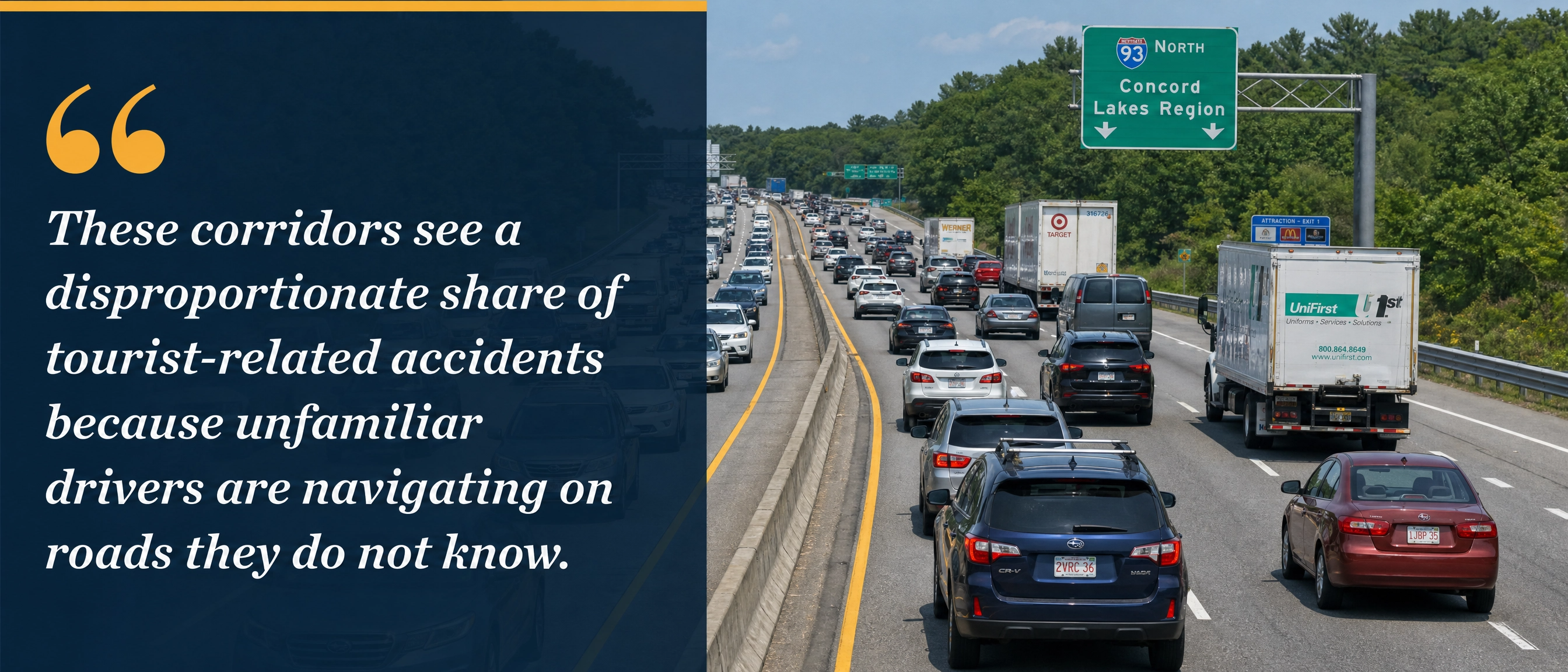
These corridors see a disproportionate share of tourist-related accidents because unfamiliar drivers are navigating on roads they do not know, often at speeds inconsistent with local traffic patterns, often with distractions from GPS devices and passengers looking at directions.
What To Do If a Tourist Hits You
The immediate steps are the same as any accident, but with a few extra items:
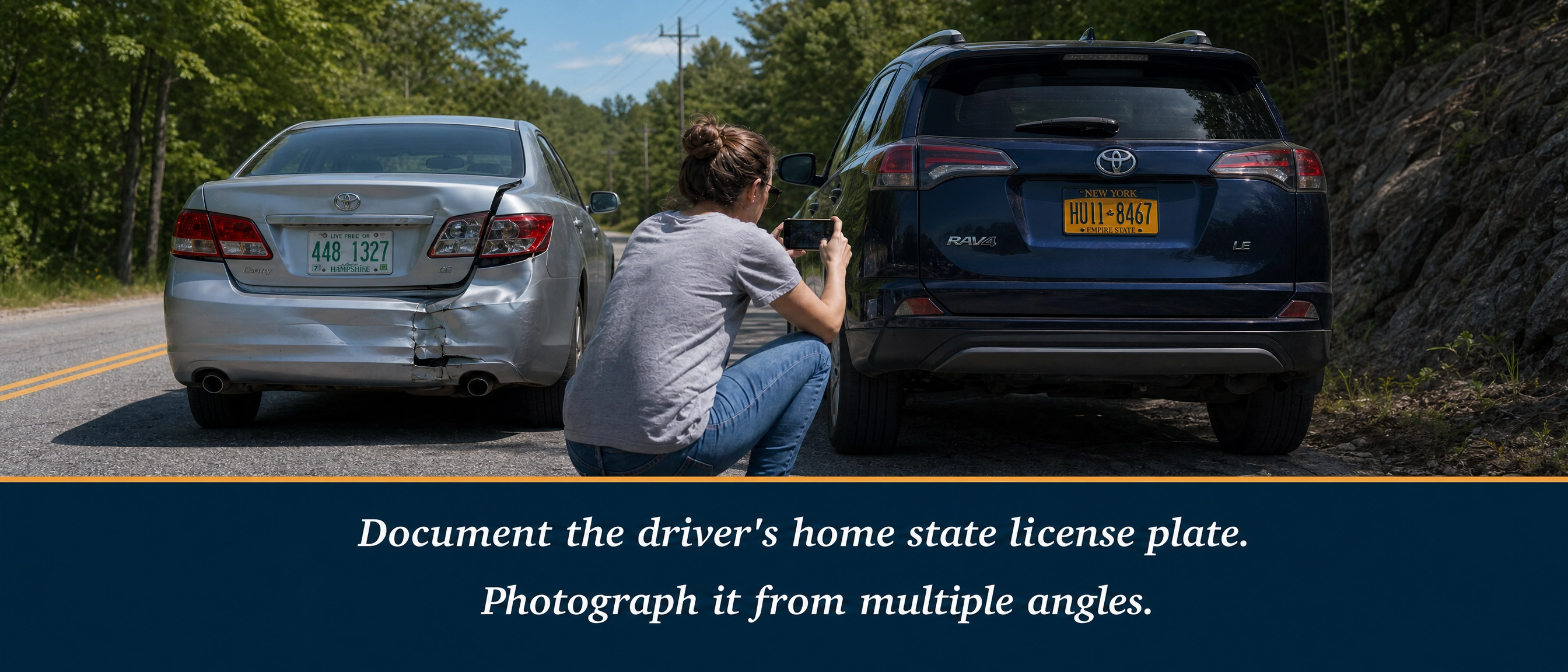
- Document the driver's home state license plate. Photograph it from multiple angles.
- Get the driver's license and insurance card. The insurance card will show the carrier and policy number for an out-of-state policy.
- Ask for a rental car agreement if the vehicle appears to be a rental. The agreement will show who the renter is and what coverage was purchased.
- Call 911 and get a police report. This is essential in any accident, but particularly so when the at-fault driver is from out of state and may return home before any follow-up investigation.
- Do not let them talk you into skipping the police report. A common refrain is "let's just exchange insurance and not involve the police." This is not in your interest. Get the report.
- See a doctor. Out-of-state insurance companies will use any gap in medical treatment as an argument that your injuries were not serious. Go to urgent care or the emergency room the same day.
- Call an attorney before you call their insurance company. The out-of-state carrier will contact you quickly. You do not have to talk to them without representation.
The attorneys at Buckley Law Offices handle car accident cases involving out-of-state drivers regularly. David Buckley has 30 years of experience navigating the insurance practices of carriers from Massachusetts and other states, and he knows how to counter the tactics they use when they would rather not pay a New Hampshire claim.
If you are not sure whether your case is worth pursuing, the consultation is free. You will get a straight answer about your situation at no cost and no obligation.
Frequently Asked Questions About Tourist Accident Claims in NH
Can I sue the out-of-state driver in New Hampshire court? Yes. If the accident happened in New Hampshire, New Hampshire courts have jurisdiction. The out-of-state driver can be served with process and required to participate in New Hampshire litigation.
What if the tourist has already left New Hampshire? This happens constantly. An attorney can still pursue your claim against their insurance carrier, which is the primary source of recovery in most cases. The driver's physical presence in New Hampshire is not required.
What if I was visiting New Hampshire when a tourist hit me? If the accident happened in New Hampshire, New Hampshire law applies regardless of where you live. Your own state's rules do not govern the claim.
Do I have to deal with a New Hampshire court if I want to sue? In most cases, the claim resolves through negotiation with the insurance carrier without going to court. If litigation is necessary, it would typically be filed in New Hampshire because that is where the accident happened and where the evidence is.
What if the tourist had a suspended or revoked license? Driving on a suspended license is a crime in New Hampshire. It does not change the fundamental structure of the insurance claim, but it is powerful evidence of the driver's negligence and can affect damages analysis.
If you were hit by an out-of-state driver in New Hampshire this summer, the complexity of your claim is real, but so is your right to full and fair compensation. New Hampshire law is on your side.
Been injured? Call Buckley! (603) 595-8801 for a free consultation.
David Buckley has been protecting NH accident victims for more than 30 years, and he knows exactly how to handle the out-of-state insurance companies that would rather close your file than pay your claim.
For more information about your rights and the deadlines that apply to your claim, call Buckley Law Offices at no cost.