On a summer weekday morning, you are driving southbound on I-93 somewhere between Manchester and Nashua. An 18-wheeler merges into your lane without signaling. The physics of what happens next are not even close to a typical fender bender. A fully loaded commercial truck can weigh 80,000 pounds.
The force involved in that collision is categorically different from anything a car-to-car crash produces.
But the force is just the beginning of what makes a truck accident case different. The law is different. The investigation is different. The defendants are different. The insurance structure is different. And the tactics used against you are different.
New Hampshire personal injury attorney David Buckley has handled commercial truck accident cases for more than 30 years, working under both New Hampshire and Massachusetts law.
Here is an honest, first-principles explanation of why these cases require specialized knowledge and why what works in a car accident case is often not enough in a truck case.
The Federal Regulatory Layer That Does Not Exist in Car Accident Cases
When an ordinary driver causes an accident, you look at New Hampshire traffic law and the driver's personal conduct. That is largely it.
When a commercial truck driver causes an accident, you are dealing with an entire additional layer of federal regulation. The Federal Motor Carrier Safety Administration, commonly called the FMCSA, sets mandatory standards for commercial trucking that override state law in many respects.
These regulations cover:
- Hours of service. Truck drivers are legally prohibited from driving more than 11 hours within a 14-hour workday and must take mandatory rest breaks. Violations of these rules are a major cause of fatigued-driving crashes.
- Electronic logging devices. Since 2017, most commercial carriers are required to use ELDs that automatically record driving time, location, speed, and braking events. This data is critical evidence in a truck accident case and can contradict what a driver claims happened.
- Vehicle maintenance and inspection. Carriers must conduct pre-trip and post-trip inspections and maintain detailed maintenance logs. Brake failures, tire blowouts, and steering defects that cause crashes often have paper trails in these records.
- Driver qualification and testing. Commercial drivers must hold a Commercial Driver's License, pass regular medical certifications, and complete mandatory training. A carrier that hired an unqualified driver or failed to conduct proper background checks can be independently liable.
- Cargo securement. Improperly loaded or secured cargo causes accidents independently of driver error. Load straps, tie-downs, and load distribution requirements are all federally mandated.
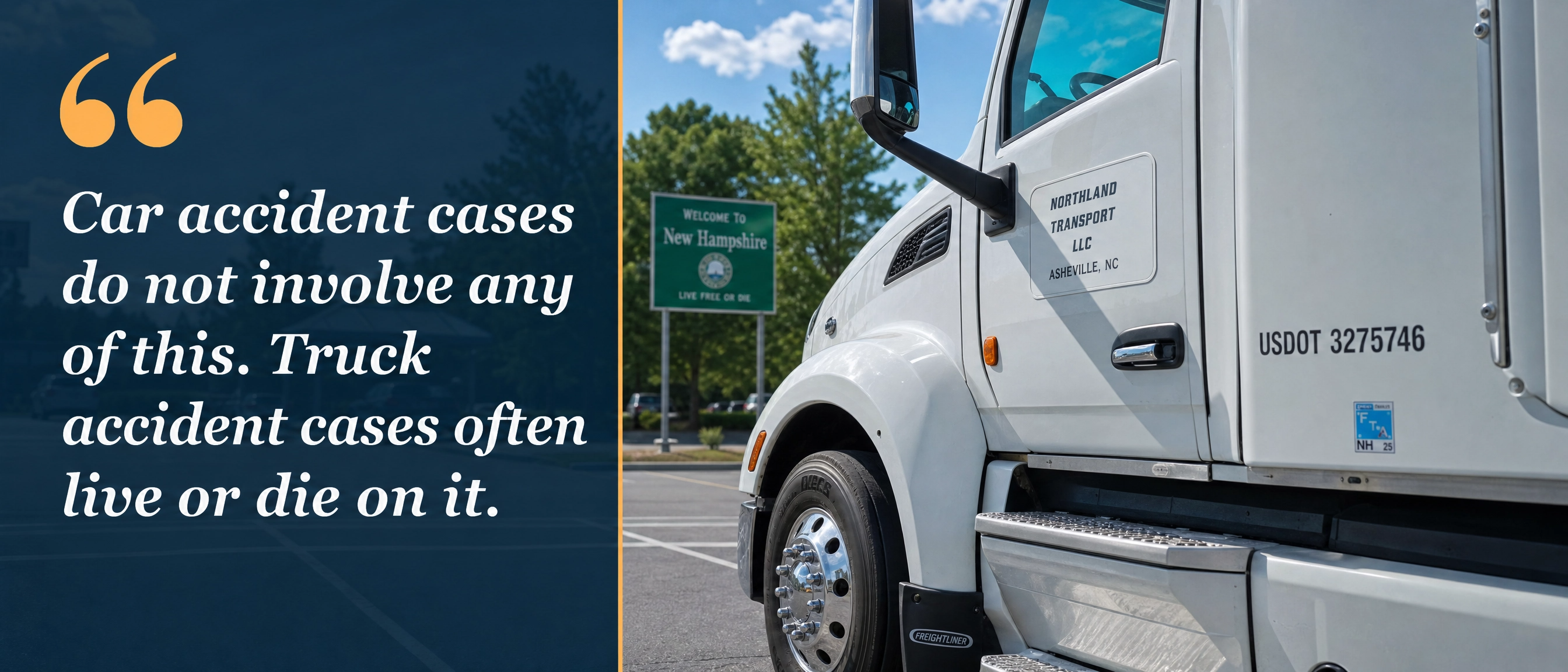
Car accident cases do not involve any of this. Truck accident cases often live or die on it.
You Are Not Just Suing the Driver
In a car accident case, you are almost always dealing with one defendant: the driver who hit you. Their personal auto insurance is the primary source of recovery.
Truck accident cases can involve multiple defendants simultaneously:
The driver may be liable for their own negligence. But in many cases, the driver is an employee, meaning the trucking company is also liable for their conduct under respondeat superior.
The trucking company has independent liability for negligent hiring, negligent supervision, failure to enforce hours-of-service rules, failure to maintain the vehicle, and failure to properly train the driver. A carrier that pushed a driver to make a delivery on a tight schedule despite fatigue may have its own conduct at issue, separate from the driver's.
The cargo shipper or loader may be liable if the crash resulted from improperly loaded cargo that shifted during transit, caused instability, or fell from the vehicle.
The truck or parts manufacturer may face product liability claims if a mechanical defect, such as a brake system failure or defective tire, contributed to the crash.
The maintenance contractor who serviced the truck may be liable if an inspection failure or negligent repair contributed to the crash.
This web of potential defendants is why truck accident cases require a comprehensive investigation from the very beginning, before any evidence disappears.
The Evidence Window Closes Fast
Here is a critical fact that most truck accident victims do not know: the trucking company's investigation team may arrive at the scene the same day as the crash.
Large commercial carriers have rapid-response legal and investigation teams. The moment a serious accident is reported, they deploy. They are gathering evidence. They are talking to witnesses. They are photographing the scene from angles that favor their defense. And in some cases, they are already working to preserve evidence selectively, keeping what helps them and documenting a chain of custody that can limit what you can access later.
The ELD data, driver logs, vehicle inspection records, and cell phone records that could prove what happened are in their possession. Some of this data is automatically overwritten after a period of time. If you do not have an attorney who acts quickly to send a legal preservation notice, critical evidence may be gone before you know you needed it.
David Buckley's approach in truck accident cases begins immediately: preserving evidence, issuing litigation holds, and requesting the black box data and ELD records before they can be altered or destroyed.
Insurance Structures Are Completely Different
A personal auto insurance policy in New Hampshire typically provides $25,000 per person in liability coverage at the state minimum. A commercial trucking company operating in interstate commerce is typically required to carry a minimum of $750,000 in liability coverage under federal law, with many carriers carrying $1 million to $5 million policies or more. For hazardous materials carriers, the federal minimum is $5 million.
This means two things.
First, the potential recovery in a truck accident case is substantially higher, which reflects the typically more severe injuries involved. Second, the insurance company on the other side has far greater resources and far stronger motivation to fight your claim.
When a trucking company's carrier gets a serious injury claim, they do not send a friendly adjuster to take your statement. They send defense lawyers. They review every social media post you have made since the accident. They order your entire medical history. They look for any prior injury they can point to as a pre-existing condition.
The playing field is not level unless you have a personal injury attorney who has handled these cases before and knows what the carrier's defense team is going to do.
Why New Hampshire's Highways Create Specific Truck Accident Risks
The Everett Turnpike, Interstate 93, and Route 101 are among the heaviest commercial truck corridors in the state. Nashua and Manchester sit at the intersection of major freight routes connecting Massachusetts to northern New England and beyond.
Several recurring factors in southern New Hampshire create elevated truck accident risk:
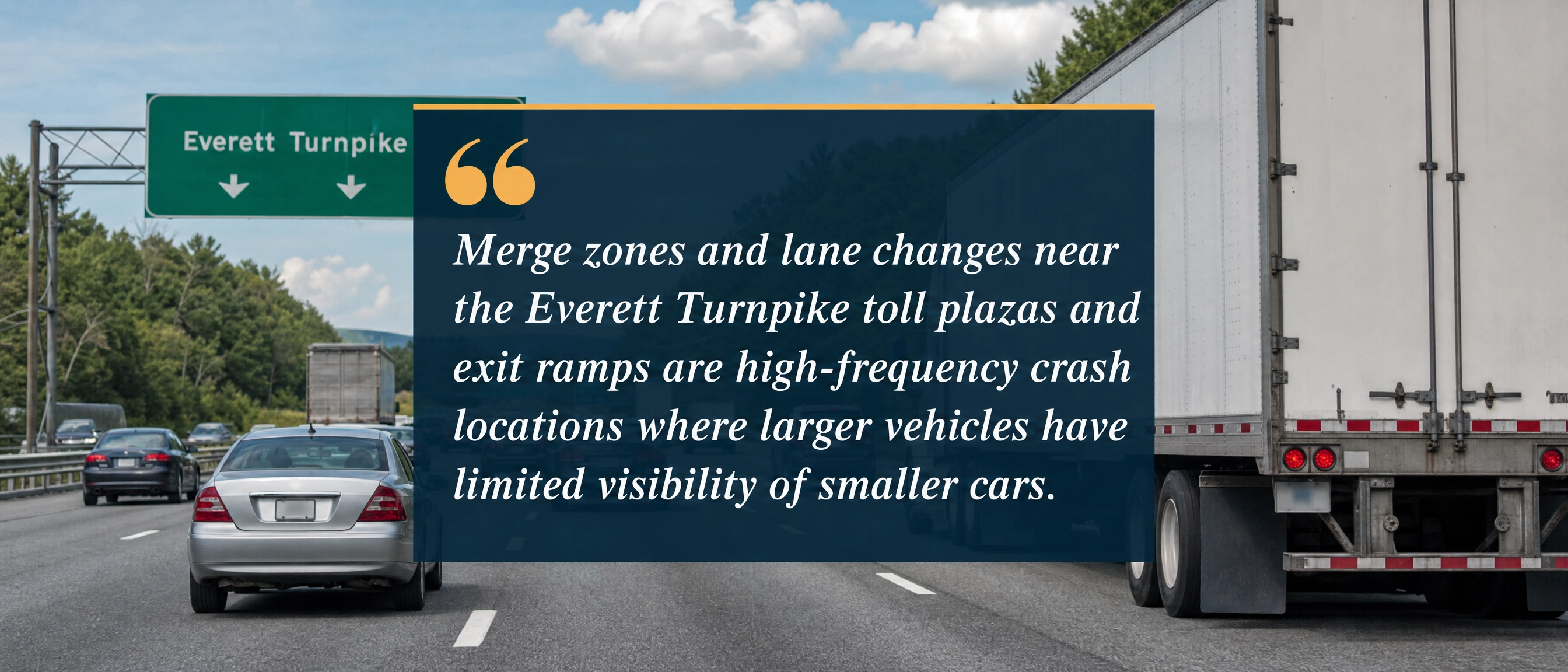
- Merge zones and lane changes near the Everett Turnpike toll plazas and exit ramps are high-frequency crash locations where larger vehicles have limited visibility of smaller cars.
- Overnight delivery runs mean fatigued drivers on these corridors in the early morning hours, a known peak time for drowsy-driving crashes.
- Construction zones on I-93 during summer months narrow lanes and create conditions where driver error by a truck driver has far more severe consequences than the same error by a passenger car driver.
- Weight and stopping distance. A fully loaded 18-wheeler traveling at 65 mph needs approximately 525 feet to stop. A passenger car needs roughly 305 feet. That distance differential is the reason rear-end truck crashes are so catastrophic.
What the Comparative Fault Argument Looks Like in Truck Cases
New Hampshire follows a modified comparative fault rule. If you are found to be more than 50 percent at fault for the accident, you cannot recover. If you are found to be less than 50 percent at fault, your recovery is reduced by your percentage of fault.
In truck accident cases, this rule is weaponized aggressively. The carrier's defense team will argue that you cut off the truck, that you were speeding, that you made a sudden lane change, or that you were following too closely. They will use any available evidence, including traffic cameras, tollbooth images, and data from your own vehicle's event data recorder, to build a case that you share fault.
Having an attorney who understands the FMCSA regulations, the ELD data, and the driver log analysis is the difference between a successful claim and a reduced or denied one.
What To Do If You Are Hit by a Commercial Truck in NH
The steps are similar to any accident, but the urgency is higher:
- Call 911. Get a police report. Make sure the truck's company name and DOT number are documented.
- Do not speak to the trucking company or their insurance. They will contact you quickly. Do not give a recorded statement without legal counsel.
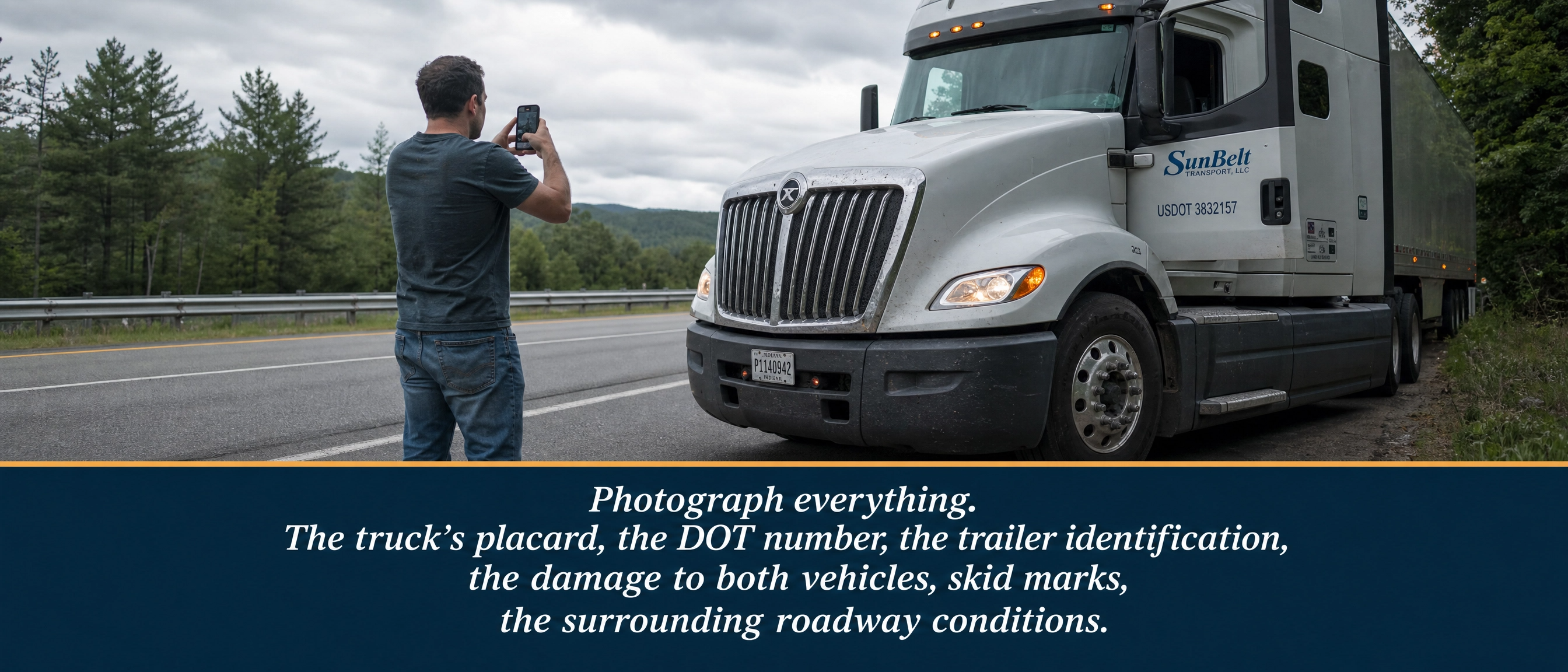
- Photograph everything. The truck's placard, the DOT number, the trailer identification, the damage to both vehicles, skid marks, the surrounding roadway conditions.
- Get medical attention immediately. Even if you feel okay. The force involved in truck crashes often produces injuries that are not immediately apparent.
- Call an attorney the same day if possible. Evidence preservation in truck cases is time-critical in a way that does not apply to passenger car accidents.
The attorneys at Buckley Law Offices handle truck accident cases across southern New Hampshire and Massachusetts. David Buckley understands the FMCSA regulatory framework, the insurance structure, and the defense tactics these carriers use. He has been doing this work for more than 30 years, and he is not intimidated by national carriers with national defense firms.
Frequently Asked Questions About NH Truck Accident Cases
Does it matter if the truck driver was an independent contractor? It can. Many trucking companies classify drivers as independent contractors to try to limit their own liability. Depending on the facts, these arguments often fail because the carrier still controls the means and methods of the work. An attorney needs to evaluate the specific relationship.
What if the truck was from out of state? FMCSA regulations apply regardless of the truck's home state. If the accident happened in New Hampshire, New Hampshire courts have jurisdiction over the claim.
Can I sue for punitive damages in NH? New Hampshire does not recognize punitive damages as a separate category. However, willful and wanton conduct can be considered as part of compensatory damages analysis.
What kinds of damages can I recover? Medical expenses, lost wages, loss of earning capacity, pain and suffering, loss of enjoyment of life, and, where applicable, wrongful death damages for the loss of a family member.
How long will my truck accident case take? These cases typically take longer than standard car accident cases because of the complexity of the investigation and the resources the carrier's insurance company brings to its defense. Your attorney should give you a realistic timeline at the initial consultation.
If you or a family member was involved in a truck accident on a New Hampshire highway, do not try to navigate this alone. The carrier's defense team is already working.
Been injured? Call Buckley! (603) 595-8801 for a free consultation. David Buckley will evaluate your case and tell you exactly what you are dealing with.