On Behalf of Buckley Law Offices
Quick Summary
A Nashua car accident claim is not only about whether the other driver was at fault. Buckley Law Offices looks early at liability, injury documentation, treatment timing, insurance coverage, photographs, witnesses, and whether the file will still make sense months later. That early review helps prevent ordinary gaps from becoming insurance-company arguments.
The first question after a crash is usually simple:
Was the other driver at fault?
That question matters. It is just not the only one.
A strong car accident claim depends on more than blame. It depends on whether the injury, the evidence, the coverage, and the timeline fit together in a way that can stand up to insurance scrutiny.
That is what Buckley Law Offices looks for early.
Liability Is Only the First Layer
Liability means who caused the crash.
In some Nashua crashes, that may look obvious. A driver ran a red light. A vehicle rear-ended another car at a stop. Someone turned left across traffic. A distracted driver drifted out of a lane.
But insurance companies often look for ways to divide fault.
They may ask:
- did the injured driver brake suddenly?
- was there enough vehicle damage?
- was traffic already slowing?
- did weather play a role?
- did both drivers make mistakes?
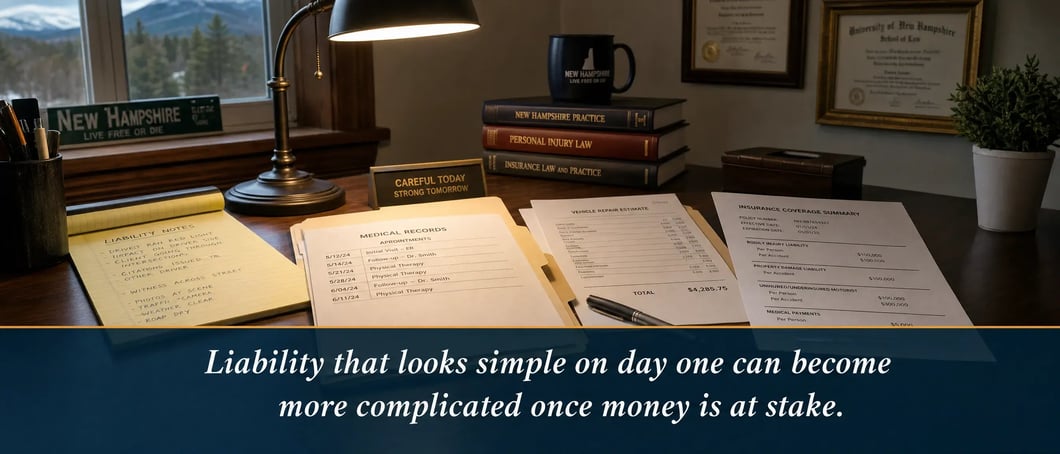
That is why photographs, witness names, police reports, roadway context, and early statements matter. Liability that looks simple on day one can become more complicated once money is at stake.
The Injury Record Has to Match the Reality
The second layer is medical documentation.
Buckley Law Offices looks at when symptoms started, when treatment began, what the first records say, and whether follow-up care is consistent.
This is not about making every case look dramatic.
It is about making the record accurate.
If a person has neck pain, headaches, back pain, numbness, shoulder pain, dizziness, or sleep disruption after a crash, those symptoms need to be identified. Waiting and hoping they fade may feel practical, but a treatment gap can become one of the first things an adjuster points to later.
The Coverage Picture Can Change the Case
The third layer is insurance.
Some people assume that if the other driver caused the crash, the other driver's insurance will take care of everything. That is not always how it works.
The at-fault driver may have limited coverage. There may be uninsured or underinsured motorist coverage. There may be medical payments coverage. Health insurance and liens may affect the final recovery.
Before an injured person signs a release, the available coverage should be understood.
That is especially true in serious auto accident cases, where early settlement can close off rights before the full injury picture is known.
A Practical Example of What Buckley Is Looking For
A Nashua driver is hit at an intersection and goes home with shoulder pain. The car is drivable, so he assumes the case is minor. He gives a quick recorded statement, misses the urgent care window, and waits to see whether the pain settles down. Three weeks later, the shoulder still hurts, but the insurer now has a clean argument: small damage, delayed care, and no early record of the full symptoms.
That is exactly the type of preventable file problem Buckley tries to catch early.
The issue is not whether the person should panic.
The issue is whether the record is being protected while the facts are still fresh.
Buckley Looks at the Whole File, Not Just the Headline
Early review should connect the pieces:
- crash facts
- vehicle damage
- scene evidence
- witness information
- medical timing
- treatment plan
- missed work or daily-life impact
- insurance coverage
- settlement posture
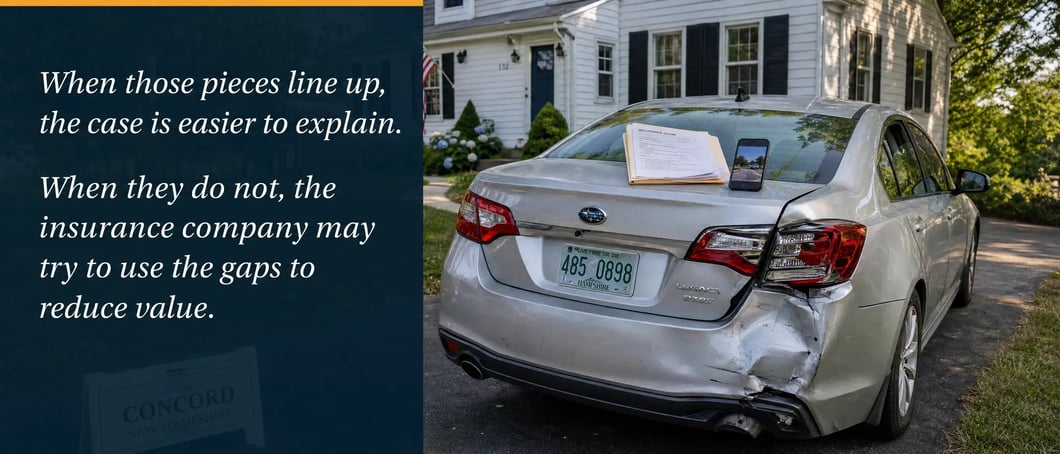
When those pieces line up, the case is easier to explain. When they do not, the insurance company may try to use the gaps to reduce value.
Not Every Crash Needs the Same Legal Response
Candid advice matters.
Some crashes are property-damage-only. Some involve soreness that resolves quickly. Some involve serious injury, ongoing treatment, wage loss, or unclear coverage. Those are different situations, and they should not be treated the same way.
Buckley Law Offices wants the file to support the strategy. If the facts are weak, the advice should be honest. If the facts show a real injury claim, the early work should protect it.
The Early Question Is About Leverage
Insurance companies negotiate from the record.
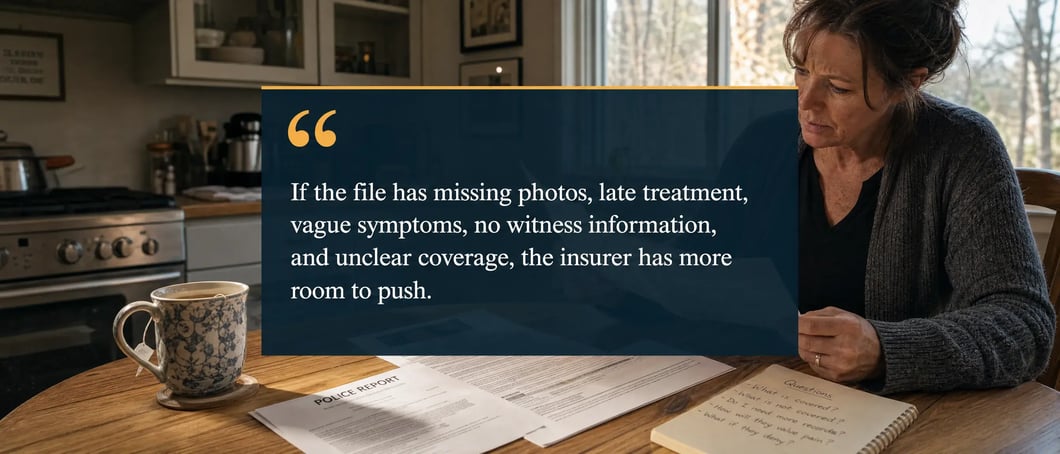
If the file has missing photos, late treatment, vague symptoms, no witness information, and unclear coverage, the insurer has more room to push. If the file has a clear timeline and organized evidence, the conversation changes.
That is why the first days after a Nashua crash matter.
They do not have to be dramatic.
They do have to be disciplined.
If you were hurt in a Nashua car accident and need help understanding what the file shows, Call Buckley at (603) 595-8801.